What Is Ectoin in Skincare? Benefits, Uses, and How It Helps Dry and Sensitive Skin
Published: 4 Nov 2026
Ectoin in Skincare is an increasingly popular skincare ingredient found in moisturizers, serums, and other products designed to support skin hydration and comfort. It is particularly interesting for people who experience dryness, sensitivity, or skin discomfort caused by environmental stress.
Unlike traditional exfoliating ingredients that focus on removing dead skin cells, ectoin works differently. It is known for its protective and water-binding properties, making it an interesting addition to modern skincare formulations.
But what exactly is ectoin? Can it help sensitive skin? Is it suitable for everyday use, and how should you include it in your skincare routine?
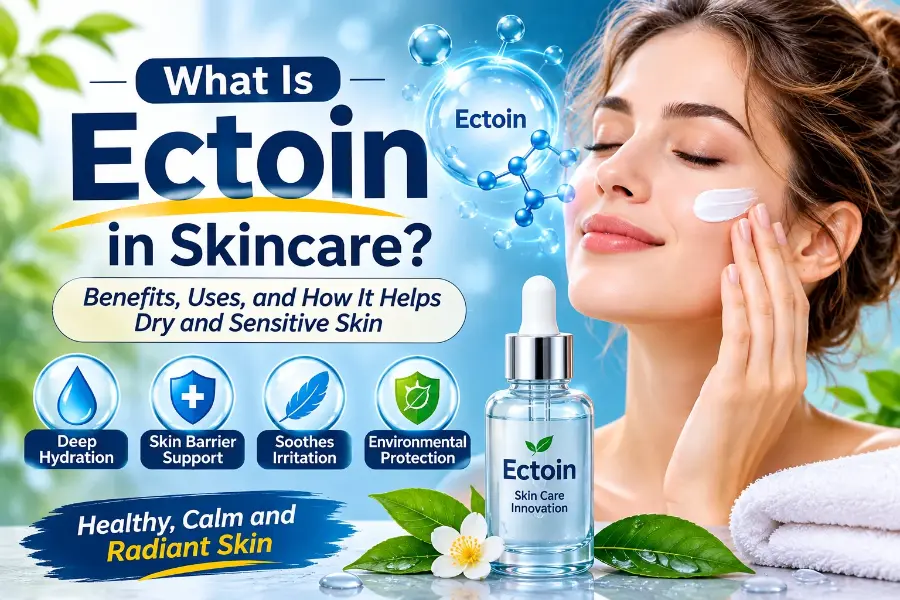
In this guide, we will explore the science behind ectoin, its potential skincare benefits, how to use it, possible side effects, and what to consider before choosing an ectoin-based product.
What Is Ectoin in Skincare?
Ectoin is a naturally occurring protective molecule known as an extremolyte. It is produced by certain microorganisms that survive in challenging environmental conditions, including high salt concentrations, extreme temperatures, and other forms of environmental stress.
These microorganisms use ectoin to help protect their cellular structures and maintain stability when exposed to difficult conditions.
Scientists have studied these protective properties and explored how ectoin can be used in skincare and cosmetic formulations.
In skincare products, ectoin is mainly used as a moisturizing, skin-conditioning ingredient. It is valued for its ability to help retain water and support the skin’s natural protective functions.
You may find ectoin in:
- Hydrating facial serums.
- Moisturizing creams.
- Sensitive-skin products.
- Barrier-supporting skincare formulations.
- Certain products designed for dry or environmentally stressed skin.
Ectoin is not an exfoliating acid or a traditional acne treatment. Its main role is to support hydration and help maintain skin comfort.
How Does Ectoin Work on the Skin?
Ectoin is known for its interaction with water molecules and biological structures.
One of its important properties is the ability to form a protective hydration environment around certain biological molecules. This is sometimes described as a hydration shell.
In cosmetic science, this property has attracted interest because it may help protect skin components from certain environmental stresses.
Ectoin is also studied for its potential role in supporting the skin barrier and reducing the effects of environmental exposure.
However, its performance depends on the complete product formulation, concentration, and individual skin characteristics.
7 Potential Ectoin Benefits for Skin
Ectoin offers several potential benefits for maintaining healthy, hydrated, and comfortable skin. Its protective, moisture-supporting properties make it a valuable skincare ingredient, especially for people dealing with dryness, dehydration, or sensitivity. From helping maintain skin hydration to supporting the natural skin barrier, the following benefits explain why ectoin in skincare has gained attention.
1. Helps Support Skin Hydration
One of the most recognized ectoin benefits is its moisturizing potential.
Dry skin often develops when the skin loses too much water or cannot maintain sufficient moisture.
Ectoin interacts with water molecules and may help create a more favorable hydration environment.
This makes ectoin an interesting ingredient for people who experience:
- Dry or tight-feeling skin.
- Dehydrated skin.
- Rough skin texture.
- Environmental dryness.
For best results, use an ectoin-containing moisturizer alongside a gentle skincare routine.
2. Supports the Skin Barrier
The skin barrier is the outer protective layer that helps prevent excessive water loss and protects the body from external irritants.
A weakened skin barrier may contribute to dryness, sensitivity, roughness, and discomfort.
Ectoin is used in some formulations designed to support skin protection and hydration.
Although it should not replace the skin’s natural barrier lipids, it may complement ingredients such as ceramides, glycerin, and other moisturizers.
3. May Help Calm the Feeling of Skin Discomfort
Some people experience discomfort when their skin is exposed to cold weather, dry air, pollution, or unsuitable skincare products.
Researchers are studying ectoin for its protective and skin-conditioning properties.
Certain formulations may help improve skin comfort by supporting hydration and reducing the impact of environmental stress.
However, do not treat ectoin as a medical treatment for eczema, dermatitis, or other inflammatory skin conditions.
4. Helps Protect Against Environmental Stress
The environment can affect skin appearance and comfort.
Common external factors include:
- Air pollution.
- Dry indoor air.
- Cold weather.
- Wind exposure.
- Ultraviolet radiation.
Ectoin has attracted scientific interest because of the protective mechanisms it uses in microorganisms exposed to extreme environments.
In skincare, it is incorporated into formulations intended to help support skin protection against environmental stress.
However, ectoin does not replace sunscreen or other proven sun-protection measures.
5. May Complement Sensitive-Skin Routines
People with sensitive skin often need products that provide hydration without unnecessary irritation.
Ectoin is generally considered a gentle cosmetic ingredient and is used in products marketed for sensitive skin.
It may complement a routine containing:
- Gentle cleansers.
- Ceramide moisturizers.
- Glycerin-based products.
- Fragrance-free skincare.
Nevertheless, every skin type is different. Even products containing generally well-tolerated ingredients can cause individual reactions.
6. Supports Skin Comfort During Seasonal Changes
Changes in temperature and humidity can affect the skin.
During winter, cold outdoor air and indoor heating may contribute to dryness. In summer, air conditioning and environmental exposure can also affect skin comfort.
An ectoin-containing moisturizer may help support hydration during these seasonal changes.
It can be used as part of a routine designed to maintain skin comfort throughout the year.
7. Works Well With Other Moisturizing Ingredients
Ectoin can be included in formulations alongside other skincare ingredients.
For example, a moisturizer may contain ectoin, glycerin, ceramides, and hyaluronic acid.
These ingredients have different functions and may complement one another in a hydration-focused skincare routine.
Choosing a well-formulated product is generally more important than focusing on one ingredient alone.
Who Can Benefit From Using Ectoin?
Ectoin may be worth considering if you experience:
- Dry or dehydrated skin.
- Skin that feels tight after cleansing.
- Environmental dryness.
- Occasional skin discomfort.
- Sensitivity to certain skincare products.
- A need for additional hydration.
It can be incorporated into routines for different skin types, including dry, normal, combination, and oily skin.
People with oily skin may prefer lightweight ectoin serums, while those with dry skin may prefer richer creams.
If you have a diagnosed skin condition, consult a dermatologist before relying on a cosmetic product to manage symptoms.
How to Use Ectoin in Your Skincare Routine
Ectoin is generally easy to incorporate into a regular skincare routine.
Follow these steps for a simple approach.
Step 1: Cleanse Your Face
Start with a gentle cleanser suitable for your skin type.
Avoid harsh cleansers that leave your face feeling excessively dry or tight.
Step 2: Apply an Ectoin Serum
If you are using an ectoin serum, apply it according to the product instructions.
Some products are designed for slightly damp skin, while others recommend applying it to clean, dry skin.
Follow the manufacturer’s directions.
Step 3: Apply Moisturizer
Use a moisturizer that suits your skin type.
Look for supporting ingredients such as ceramides, glycerin, and hyaluronic acid.
These ingredients can complement a hydration-focused routine.
Step 4: Apply Sunscreen in the Morning
Finish your morning routine with a broad-spectrum sunscreen with SPF 30 or higher.
Ectoin is not a sunscreen and cannot replace proper sun protection.
Can You Use Ectoin Every Day?
Many ectoin-containing skincare products are formulated for daily use.
Depending on the manufacturer’s instructions, you may use an ectoin serum or moisturizer in the morning, evening, or both.
Because ectoin is not a strong exfoliating ingredient, it can generally fit into simple daily skincare routines.
However, always follow the product label instructions.
What Ingredients Can You Combine With Ectoin?
Ectoin can be used alongside several common skincare ingredients.
Ectoin and Hyaluronic Acid
Hyaluronic acid is a humectant that attracts water and helps maintain skin hydration.
Combining it with ectoin may be useful in moisturizing formulations.
Ectoin and Ceramides
Ceramides help maintain the skin barrier and reduce excessive water loss.
An ectoin and ceramide moisturizer may be a good option for people seeking extra hydration and barrier support.
Ectoin and Niacinamide
Niacinamide is a form of vitamin B3 that supports the skin barrier and helps improve the appearance of uneven skin tone.
These ingredients can generally be included in the same skincare routine.
Ectoin and Vitamin C
Vitamin C is an antioxidant used to improve the appearance of dullness and uneven skin tone.
Ectoin can be used alongside vitamin C in a well-formulated skincare routine.
Ectoin and Retinol
Retinol is a vitamin A derivative commonly used for acne, uneven texture, and signs of skin aging.
Ectoin may complement a moisturizing routine that includes retinol.
However, if retinol causes dryness or irritation, use a suitable moisturizer and introduce active ingredients gradually.
Does Ectoin Have Any Side Effects?
Ectoin is generally considered a well-tolerated cosmetic ingredient.
However, no skincare ingredient is guaranteed to suit everyone.
Possible reactions may include:
- Mild irritation.
- Redness.
- Itching.
- Sensitivity to another ingredient in the formulation.
- Contact reactions in people sensitive to particular product components.
In many cases, a reaction may be related to fragrance, preservatives, or another ingredient rather than ectoin itself.
If you experience persistent irritation, stop using the product and seek professional advice.
If you develop swelling, severe itching, or difficulty breathing, seek immediate medical attention.
Is Ectoin Suitable for Sensitive Skin?
Ectoin is commonly included in sensitive-skin products because of its moisturizing and protective properties.
It may be a useful ingredient for people who want a gentle hydration-focused routine.
However, sensitive skin can react to many different substances.
Before using a new product, test it on a small area of skin, following the product instructions.
If you have eczema, rosacea, or another diagnosed skin condition, ask your dermatologist whether the product is appropriate.
Ectoin vs. Hyaluronic Acid: What Is the Difference?
Both ectoin and hyaluronic acid are used in moisturizing skincare products, but they differ in key ways.
| Feature | Ectoin | Hyaluronic Acid |
|---|---|---|
| Main role | Skin conditioning and hydration support | Water-binding hydration |
| Ingredient type | Extremolyte | Humectant |
| Common use | Barrier-supporting formulations | Hydrating serums and creams |
| Skincare focus | Hydration and environmental stress support | Moisture retention |
| Product forms | Serums and moisturizers | Serums, creams, and gels |
Neither ingredient is universally better.
Some products combine both ingredients to provide different types of moisturizing support.
How Long Does Ectoin Take to Work?
The time needed to notice changes depends on the formulation, skin condition, and individual response.
Some people may notice improved skin comfort shortly after using a moisturizing product.
Changes in dryness and overall skin appearance may take longer with consistent use.
Ectoin should not be expected to remove acne scars, eliminate wrinkles, or completely repair a damaged skin barrier overnight.
For persistent dryness or irritation, consult a dermatologist rather than continuously adding new products.
Common Mistakes to Avoid When Using Ectoin
Using ectoin correctly can help you get the most out of your skincare routine, but certain mistakes may limit its benefits. Although ectoin in skincare is generally well tolerated, use it consistently, choose suitable products, and keep realistic expectations. Understanding these common mistakes can help you use ectoin more effectively and support healthier-looking skin.
1. Expecting Immediate Results
Ectoin is a skincare ingredient, not an instant solution for every skin problem.
Give your routine time and evaluate the product based on realistic expectations.
2. Ignoring Other Ingredients
A product’s performance depends on its complete formulation.
Check the ingredient list instead of choosing a product based only on its ectoin content.
3. Skipping Moisturizer
An ectoin serum may not provide enough moisture on its own, particularly if you have very dry skin.
Use an appropriate moisturizer when needed.
4. Forgetting Sunscreen
Ectoin does not protect your skin from the sun like a tested sunscreen.
Use broad-spectrum SPF 30 or higher during the day.
5. Using Too Many Products at Once
Introducing several new skincare products at once can make it hard to identify the cause of irritation.
Introduce new products gradually.
Recommended Ectoin Skincare Products
If you want to add ectoin to your skincare routine, a well-formulated serum or moisturizer is a good place to start. The following products contain ectoin or combine it with other moisturizing and skin-barrier-supporting ingredients.
1. The INKEY List Ectoin Hydro-Barrier Serum
Best for: Daily hydration and skin barrier support
This serum contains 2% ectoin and is designed to support skin hydration and help maintain a healthy-looking skin barrier. It is a good option for readers looking for a dedicated ectoin treatment.
Why consider it?
- Contains 2% ectoin.
- Supports skin hydration.
- Suitable for hydration-focused skincare routines.
- Can complement a daily moisturizing routine.
Check the product: Find The INKEY List Ectoin Serum on Amazon
2. Paula’s Choice 7% Ectoin + Hyaluronic Acid Milky Serum
Best for: Hydration and dry skin
This milky serum combines ectoin with hyaluronic acid to provide complementary hydration and skin-conditioning benefits. Consider it if you want a dedicated ectoin and hyaluronic acid formula.
Why consider it?
- Contains 7% ectoin, according to the product’s stated formulation.
- Combines ectoin with hyaluronic acid.
- Supports skin hydration.
- Fits into moisturizing skincare routines.
Check the product: Find Paula’s Choice Ectoin Serum on Amazon
3. Dr. Jart+ Ceramidin Ectoin-Infused Cream
Best for: Dry skin and barrier-focused moisturizing
This moisturizing cream combines ectoin with ceramides and other conditioning ingredients. It may suit people looking for a richer moisturizer to complement their skincare routine.
Why consider it?
- Contains ectoin.
- Features multiple ceramides.
- Provides moisturizing care.
- Suitable for routines focused on skin barrier support.
Check the product: Find Dr. Jart+ Ceramidin Cream on Amazon
4. Prequel Multi-Quench Plumping Hydration Serum
Best for: Dehydrated skin and layered hydration
This hydrating serum combines ectoin with ingredients such as polyglutamic acid and glycerin. Its formulation makes it another option for readers interested in supporting skin hydration.
Why consider it?
- Contains ectoin.
- Includes polyglutamic acid.
- Features glycerin for hydration.
- Complements a daily moisturizing routine.
Check the product: Find Prequel Multi-Quench Serum on Amazon
How to Choose the Right Ectoin Product
The best product depends on your skin type, preferences, and skincare needs.
- For daily hydration: Consider The INKEY List Ectoin Hydro-Barrier Serum.
- For dry skin: Consider Paula’s Choice Ectoin + Hyaluronic Acid Serum.
- For richer moisturizing care: Consider Dr. Jart+ Ceramidin Ectoin-Infused Cream.
- For dehydrated skin: Consider Prequel Multi-Quench Hydration Serum.
Always check the current ingredient list, product availability, and manufacturer’s instructions before purchasing. Introduce new products gradually and patch-test if you have sensitive skin.
Note: Individual results vary, and no ectoin product should be considered a medical treatment for a skin condition.
FAQs
Here are answers to some common questions about ectoin, its skincare benefits, safety, and how to use it effectively in your daily routine.
Ectoin is used in skincare products to support hydration, skin conditioning, and protection against environmental stress.
Its common uses include:
- Helping maintain skin moisture.
- Supporting the natural skin barrier.
- Improving skin comfort.
- Protecting against environmental stressors.
Overall, ectoin helps keep skin hydrated, comfortable, and better protected from environmental stress.
Yes, ectoin may benefit dry skin when included in moisturizing skincare formulations. It can work alongside other hydrating ingredients to help maintain skin moisture.
It pairs well with:
- Glycerin.
- Hyaluronic acid.
- Ceramides.
- Panthenol.
Together, these ingredients can help keep dry skin hydrated, soft, and comfortable.
Ectoin is generally considered a gentle skincare ingredient and is commonly included in products formulated for sensitive skin.
Potential benefits include:
- Supporting skin hydration.
- Helping maintain barrier function.
- Improving skin comfort.
- Complementing gentle skincare routines.
However, individual reactions are possible, so a patch test is recommended.
Yes, many Ectoin skincare products are formulated for daily use.
For a simple routine:
- Apply an ectoin serum or moisturizer as directed.
- Use it after cleansing.
- Follow with moisturizer if needed.
- Apply sunscreen during the daytime.
Always follow the product manufacturer’s instructions.
Yes. Ectoin and niacinamide can generally be used together in the same skincare routine.
Their complementary benefits include:
- Ectoin supports hydration and skin comfort.
- Niacinamide helps support the skin barrier.
- Both can fit into routines designed for dry or sensitive skin.
Together, ectoin and niacinamide can complement each other in a gentle, skin-supporting skincare routine.
Ectoin is not an established wrinkle-removal treatment. However, its moisturizing properties may temporarily improve the appearance of fine lines caused by dryness.
It may help by:
- Supporting skin hydration.
- Reducing the appearance of dehydration-related fine lines.
- Improving the appearance of skin texture.
It should not replace proven anti-aging ingredients or sun protection.
Neither ingredient is universally better because they serve somewhat different skincare purposes.
- Ectoin: Valued for hydration-related and protective properties.
- Hyaluronic Acid: Primarily helps attract and retain water in the skin.
Both ingredients can complement each other in a moisturizing skincare routine.
Ectoin is used in barrier-supporting cosmetic formulations and may help improve skin hydration and comfort.
Its potential contributions include:
- Supporting skin moisture.
- Helping maintain barrier function.
- Improving skin comfort.
- Complementing moisturizers containing ceramides.
However, it is not a medical treatment for skin barrier disorders.
Yes. Ectoin and retinol can generally be used together in a skincare routine. Ectoin may complement moisturizing care when using retinol.
For better results:
- Introduce retinol gradually.
- Apply ectoin as directed.
- Use a suitable moisturizer.
- Apply broad-spectrum sunscreen during the day.
If irritation develops, reduce retinol use and consult a dermatologist if necessary.
Pregnancy-specific clinical research on topical ectoin is limited. Although it is used in cosmetic skincare formulations, its safety during pregnancy has not been fully established.
Consider these precautions:
- Stop using the product if you experience irritation or an unexpected reaction.
- Consult your healthcare professional before starting a new skincare product.
- Check the complete ingredient list.
- Avoid products containing other ingredients that your healthcare professional has advised against.
When in doubt, consult your healthcare professional to ensure your skincare routine is appropriate during pregnancy.
Understanding how ectoin works can help you make informed choices and include it appropriately in your skincare routine.
Final Thoughts
Ectoin is an interesting skincare ingredient that has gained attention because of its unique biological properties and potential role in hydration-focused formulations.
Its moisturizing and skin-conditioning characteristics make it worth considering for people who experience dryness, environmental stress, or occasional skin discomfort.
It can also complement other skincare ingredients, including ceramides, hyaluronic acid, and niacinamide.
However, keep realistic expectations. Ectoin is not a cure for eczema, acne, wrinkles, or other medical skin conditions.
Choose a well-formulated product, maintain a gentle routine, and pay attention to how your skin responds.
Good skincare is not about following every new trend. It is about choosing ingredients that support your skin’s individual needs.
Medical and Scientific References
- PubMed – Scientific literature on ectoin and its biological protective properties: https://pubmed.ncbi.nlm.nih.gov/?term=ectoin+skin
- PubMed – Ectoin and skin barrier research: https://pubmed.ncbi.nlm.nih.gov/?term=ectoin+skin+barrier
- PubMed – Ectoin in dermatology and cosmetic applications: https://pubmed.ncbi.nlm.nih.gov/?term=ectoin+dermatology
- DermNet – Skin barrier and skincare information: https://dermnetnz.org/
- American Academy of Dermatology – Skin care basics: https://www.aad.org/public/everyday-care/skin-care-basics
Medical disclaimer: This article is for educational purposes only. It does not replace professional medical advice, diagnosis, or treatment. Consult a qualified dermatologist or healthcare professional regarding persistent skin problems.




- Be Respectful
- Stay Relevant
- Stay Positive
- True Feedback
- Encourage Discussion
- Avoid Spamming
- No Fake News
- Don't Copy-Paste
- No Personal Attacks
- Be Respectful
- Stay Relevant
- Stay Positive
- True Feedback
- Encourage Discussion
- Avoid Spamming
- No Fake News
- Don't Copy-Paste
- No Personal Attacks
